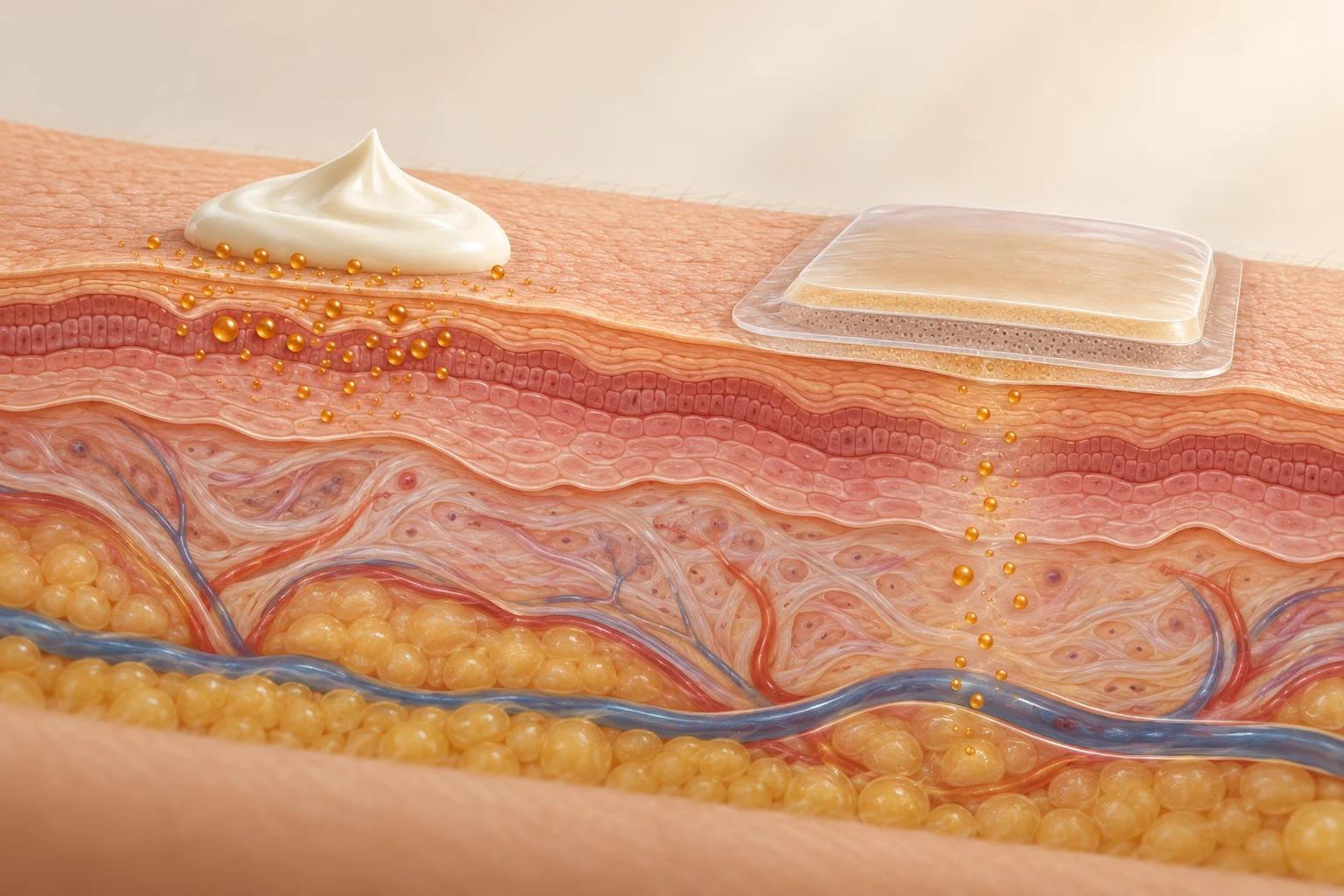
Cannabis topicals versus transdermal patches: what the label means
A cream and a patch may both sit on the skin, but that doesn’t mean they deliver cannabinoids in the same way. The useful distinction is the intended destination: topical products are designed to act in local tissue, while transdermal products are designed to carry an ingredient through the skin and into the bloodstream. That difference can change what a product is meant to do, and what questions are worth asking about it. [1]
Topical means “applied to the body surface”
Cannabis topicals include products such as creams, balms, oils, gels and salves. Health Canada also includes patches in its list of topical formats, showing why the package shape alone can be confusing. A product called a topical is generally intended for local application, but the word by itself doesn’t establish how much cannabinoid reaches deeper tissue—or whether any reaches the bloodstream. [2]
Think of “topical” as describing where a product is applied, not a guarantee about what happens after. Products can differ in their ingredients and formulation, and a label’s broad format name may not answer the key question: is it designed for local action or systemic delivery? [1][3]
Transdermal describes a route across the skin
A transdermal patch is designed to move an active ingredient across the skin and into systemic circulation. In conventional medicines, patches are engineered delivery systems, often designed to release an ingredient over a set wear period. A cannabis patch marketed as transdermal makes a stronger claim about its intended delivery route than a balm or cream does. [1]
That label still describes a design goal, not proof that every product delivers a predictable amount. Skin acts as a barrier, and cannabinoids have properties that make crossing it challenging. Formulation matters: researchers have studied delivery approaches such as patches, gels and permeation enhancers, but results from one formula or study cannot automatically be applied to every product on a shelf. [3][4]
What the evidence can—and cannot—tell you
Health Canada says there isn’t enough information to establish the timing, duration or specific risks of cannabis topical use, and notes that topical application may cause localized reactions such as itching or rash. A review of cannabinoid skin research likewise describes important evidence gaps. These limits make broad promises about reliable absorption or effects difficult to evaluate from the format name alone. [2][3]
Research on a particular transdermal system can show that delivery is possible under the conditions studied. For example, one exploratory study measured CBD and THC in healthy adults using a specific delivery system. Its findings are about that system and study design; they don’t prove that all cannabis patches work alike or establish an outcome for every user. [4]
A practical label-reading checklist
When comparing products, look for the exact words used to describe the route: “topical” or “transdermal.” Check which cannabinoids are listed, the amount per container or unit, the intended wear or application instructions, and whether the package identifies the product’s intended use. If those details are missing, the label may not give enough information to judge what the product is designed to deliver. [1][2]
Also check which organization regulates the product where it is sold. Rules and product categories vary by jurisdiction, so a term used on one market’s package may not carry the same meaning everywhere. A certificate of analysis or ingredient list can help answer some composition questions, but neither one alone proves how much will cross the skin. [2][3]
The simple takeaway: a product can be applied to skin without being designed to deliver cannabinoids through it. Read “topical” and “transdermal” as clues to intended route, then look for product-specific information and keep the limits of the evidence in view. [1][2][3]
