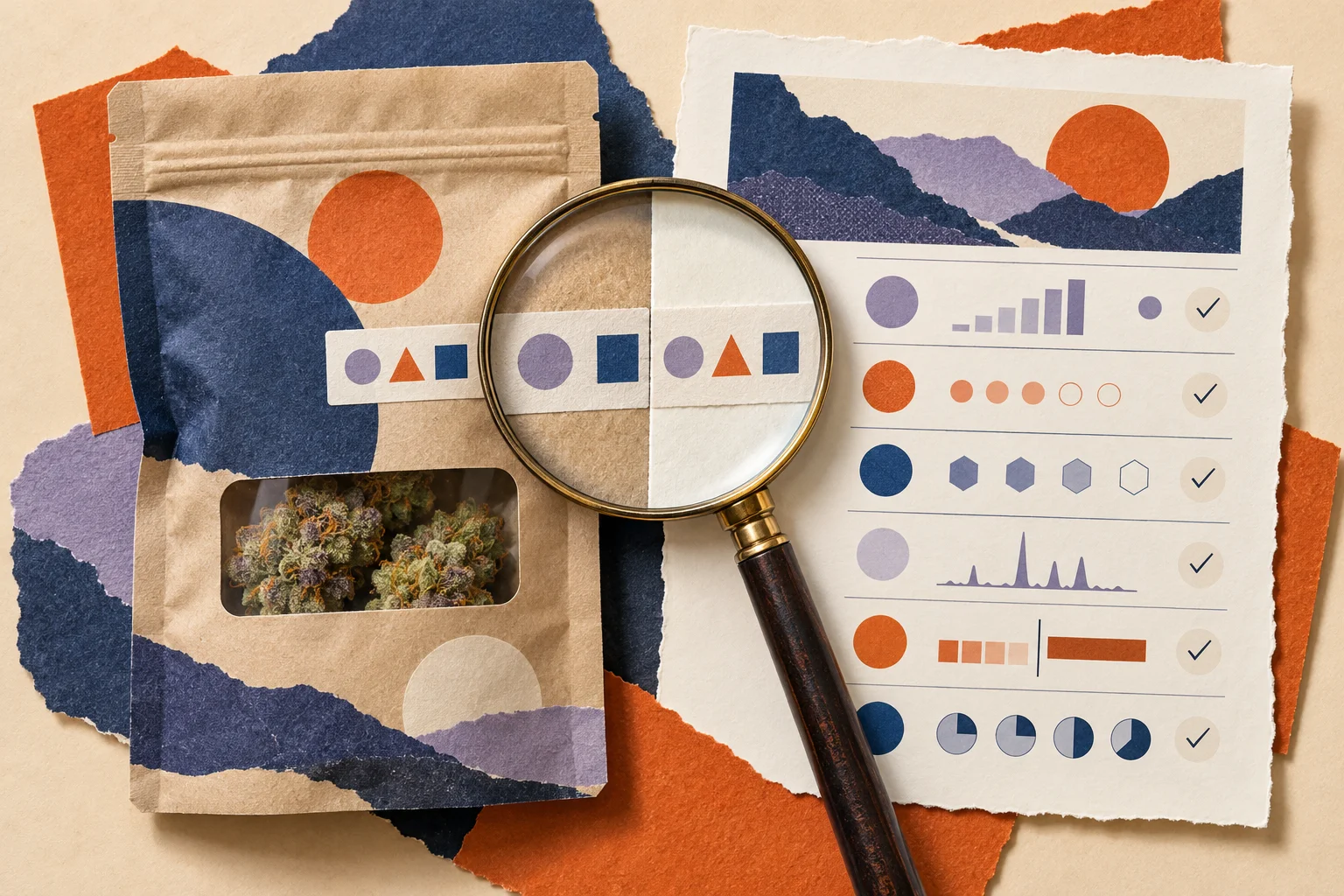
A cannabis product label gives you a quick summary. A Certificate of Analysis, or COA, gives you a closer look at laboratory testing. The useful question is not simply “Is there a QR code?” It is “Does this report belong to this product, and what exactly does it tell me?” [1][2]
Start with the product in your hand
Look for the product name and a batch or lot number on the package. Then open the COA and compare those details. In California’s regulated market, testing uses a representative sample from a batch, and distributors must check that the COA corresponds to the correct batch. That means a report for the same brand or product type may still be the wrong report for your package. [2]
A QR code is just a route to information, not proof that the information matches. An Oregon state report on online hemp edibles found examples where codes led to a general website instead of the specific report, or where a product’s batch number was missing. Those findings concern the products and market examined in that report; they should not be treated as a survey of all cannabis products. [3]
Read the potency in context
Check whether a number describes one serving, the whole package, or a concentration such as a percentage. Those measurements answer different questions. For an edible, a package total is not the same as the amount in one piece. For flower, a percentage describes concentration by weight, not the amount in a single puff. If the label and report use different units or serving sizes, pause before comparing the figures. [3]
A high THC number is not a quality score. It tells you about one measured part of the product, not its overall character or how it will affect a particular person. In a 2026 audit of 63 Massachusetts cannabis flower products, regulators found 13 samples outside the state’s acceptable range for labeled potency. This was a specific shelf audit, not evidence that every label is inaccurate. It does show why a printed percentage should not be read as an exact promise. [4]
Look beyond the headline number
A COA may cover several kinds of testing. California requires batch testing for cannabinoids and terpenes, as well as checks for contaminants including pesticides, heavy metals, microbial impurities, mycotoxins, residual solvents, and foreign material. Scan the report for the separate test categories and their pass or fail outcomes; a prominent THC result alone does not summarize all of them. Requirements vary by jurisdiction, so California’s list is an example, not a universal rule. [1]
A pass has a specific scope. It means the tested batch met the applicable testing requirements shown in that report. It does not establish that every individual package was tested separately, predict an individual experience, or settle whether a product is legal where you live. California’s rules describe representative sampling of a batch, while Massachusetts’ shelf audit retested products and found some outside its acceptable range. [2][4]
A simple check before you decide
Match the product and batch number first. Confirm whether the potency is per serving or per package, and make sure the units line up. Look at each reported test category rather than stopping at THC. If you cannot find a report for the exact batch, or its product details do not match, treat that as missing information—not as evidence that the product passed. A readable label and a matching report make product information easier to assess, while leaving the limits of testing clear. [1][2][3]
