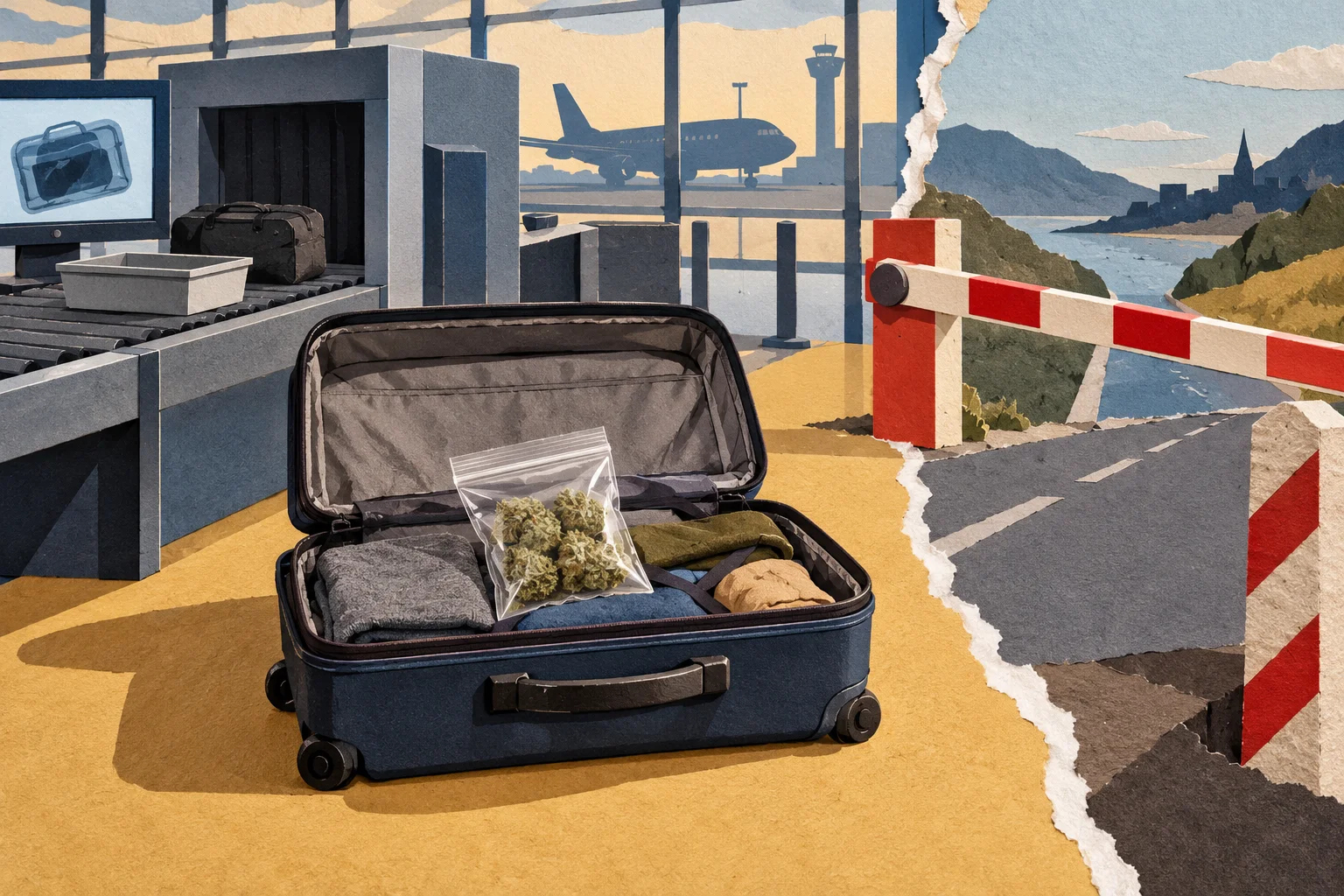
Legal where you bought it. Legal where you’re going. So it can go in your bag, right? Travel is where that tidy bit of logic can fall apart. A purchase receipt only tells you something about the sale; it doesn’t settle what you may carry, possess or use at every point on your route. [1][2]
The border is a change of rules
A border can turn an ordinary personal item into a prohibited import or export. Canada is a clear example: its government says taking cannabis across the international border is illegal, including for medical use. That applies whether you’re entering or leaving Canada, even though cannabis is legal and regulated there. [1]
The Canada Border Services Agency says the restriction covers cannabis products brought for personal use or as a gift. It also includes CBD products derived from cannabis or hemp, unless a valid Canadian government permit or exemption applies. The agency says undeclared cannabis when entering Canada may lead to seizure, arrest or monetary penalties. [2]
That makes the “I’ll just leave it in my luggage” idea a bad shortcut. A border officer may examine goods, and a familiar package or prescription doesn’t by itself answer whether a border crossing is permitted. For Canada, the relevant guidance points to a government permit or exemption, not simply a personal reason for carrying it. [2]
An airport checkpoint asks a different question
Airport security screening can add another layer, but screening rules are not a travel permission slip. In the United States, TSA says cannabis and some cannabis-infused products remain illegal under federal law, with stated exceptions for products at or below 0.3 percent THC by dry weight or FDA-approved products. TSA also says its officers focus on security screening rather than searching for drugs; if they discover an illegal substance, they refer it to law enforcement. [3]
That distinction matters. “TSA doesn’t search for it” is not the same as “TSA says it is legal to carry.” The agency’s page describes what may happen during screening, while the federal-law statement describes a separate legal dimension. Neither statement establishes the rules in another country, at your destination, or for every product. [3]
Think in legs, not just destinations
Before a trip, write down each place where your plans change: where you buy something, where you carry it, where you might use it, and every border or airport you pass through. Then check the official rules for each jurisdiction and each part of the trip. This is especially useful on itineraries that connect through a country you weren’t planning to visit; a layover still puts you inside that place’s travel system. [1][2][3]
If the route crosses Canada’s international border, the practical takeaway from Canadian guidance is simple: don’t carry cannabis across it unless you have the applicable government authorization. If you’re flying through a U.S. airport, read the current TSA policy as screening guidance, not as a blanket clearance to possess or transport cannabis. [2][3]
A calmer travel plan starts with separating four questions: Can I buy it here? Can I possess it here? Can I use it here? Can I carry it across the next boundary? A “yes” to one doesn’t supply the answer to the others. When the official guidance does not clearly cover your route or product, treat that uncertainty as unresolved and check with the relevant authority before travel. [1][2][3]
