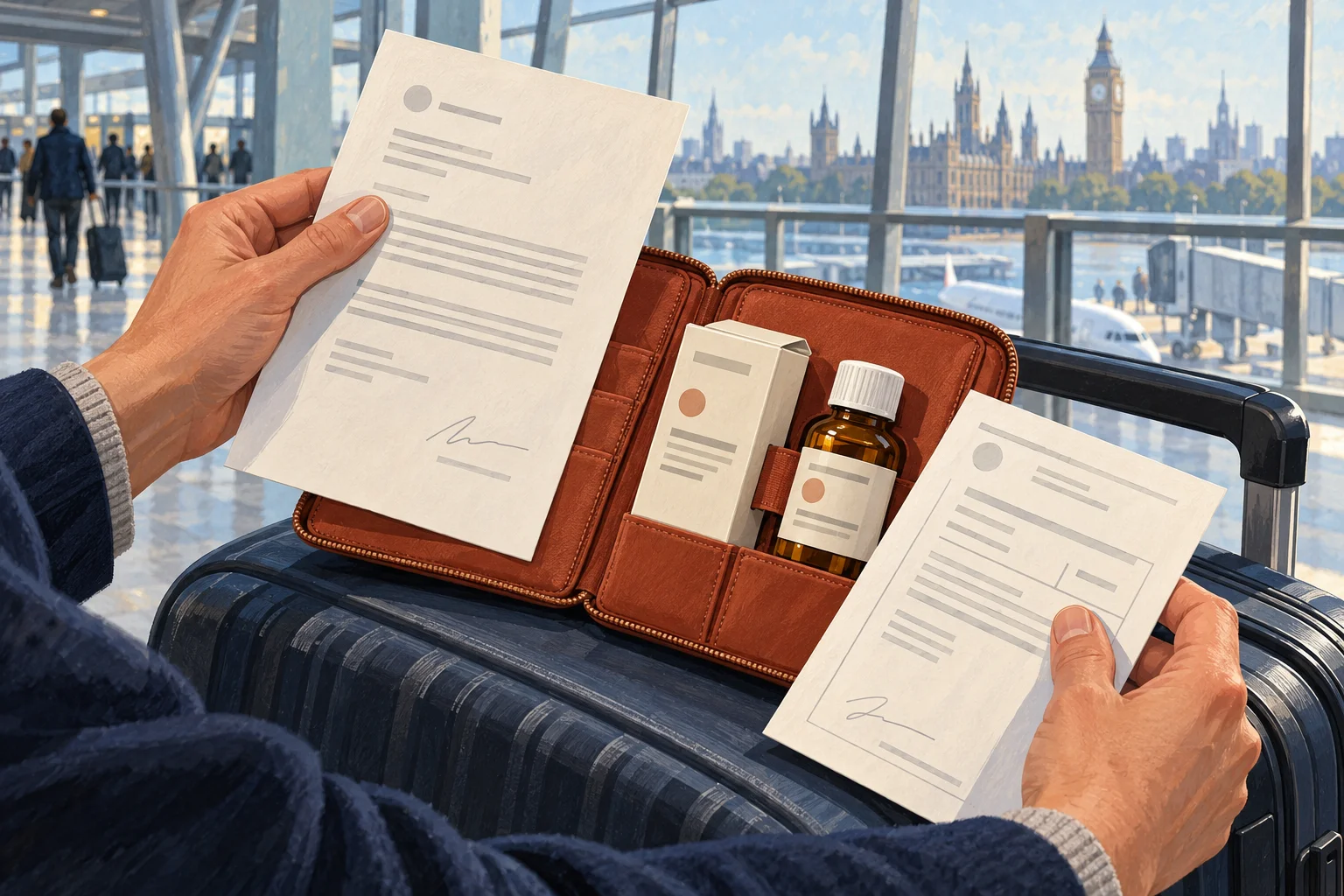
The useful question before a trip is not simply, “Do I have a prescription?” UK entry rules also ask what controlled substance the medicine contains, where it was prescribed, how much you are carrying, and whether you are visiting or returning home. A document checklist helps you spot gaps before you reach the border. [1][2]
Start with the medicine, not the label
“Medical cannabis” can describe different products. Ask your prescribing clinician or pharmacist whether the particular medicine contains a controlled drug, and check the UK controlled-drug schedule for that substance. The Home Office’s personal import guidance covers qualifying medicines lawfully prescribed and dispensed in the traveller’s country of habitual residence; it sets out conditions for different schedules. A product’s general description alone does not tell you which rules apply. [1][2]
The standard personal import policy covers up to a three-month supply of certain controlled medicines, including schedule 2 to 4 (part I) drugs in medicinal-product form and medicines in schedules 4 (part II) and 5. Medicines must be lawfully prescribed and dispensed to you, and carried on your person as you enter or leave the UK. Schedule 1 medicines generally cannot be brought into the UK without a licence; a Schengen Certificate does not replace one. Check the schedule rather than assuming every cannabis-based medicine follows the same route. [1]
Build a border document pack
For qualifying medicine, the Home Office recommends a letter from your doctor or prescribing clinician. Its guidance says the letter should show your name; the prescribed medicine, dose, strength and frequency; and the prescriber’s signature and professional registration details. It should also make clear, alongside the prescription or letter, that the amount is no more than a three-month supply for your travel dates. Keep the medicine in its original packaging where possible, and make sure the paperwork describes what you are actually carrying. [1]
A separate GOV.UK page gives a visitor-facing checklist that includes travel dates and the amount of medicine you have, as well as your name, medicine details, dose, strength and prescriber’s signature. That makes a useful practical cross-check: take the prescription or clinician letter, confirm the dates and quantity are consistent, and have the documents accessible during the journey. The published guidance says the medicine may be taken away at the border if you cannot prove it was prescribed for you. [2]
Your residency changes the route
The personal import policy is for visitors bringing qualifying medicine prescribed in their country of habitual residence. It does not apply to someone habitually resident in the UK who received controlled drugs abroad; the Home Office says those travellers should contact its Drug and Firearms Licensing Unit before returning with them. A UK resident’s prescription from overseas therefore should not be treated as equivalent to a visitor’s paperwork. [1][2]
If you are a temporary resident or your UK stay will run beyond three months, the guidance says to bring only a small supply of prescribed controlled-drug medicine, up to three months, then consult a UK clinician about further supply. It says controlled medicines cannot be posted to you from overseas. For an exceptional case involving more than three months’ supply, the Home Office asks travellers to contact the unit well ahead of travel with supporting information; do not assume an application will be approved. [1]
Check both ends of the journey
Permission to enter the UK does not settle the rules for your departure country or any transit stop. The Home Office advises travellers to check whether they can lawfully take the medicine out of the country where they normally live; its travel guidance also says other countries have their own import rules. Confirm the medicine and quantity with official authorities for each leg, and resolve any uncertainty before travelling. [1]
In short, prepare the prescription and clinician letter, verify the controlled-drug schedule, check the supply limit and confirm which residency route applies. Those checks make the paperwork clearer, but they are not a substitute for checking the current official rules for your specific medicine and itinerary. [1][2]
